Reissue of a Legend
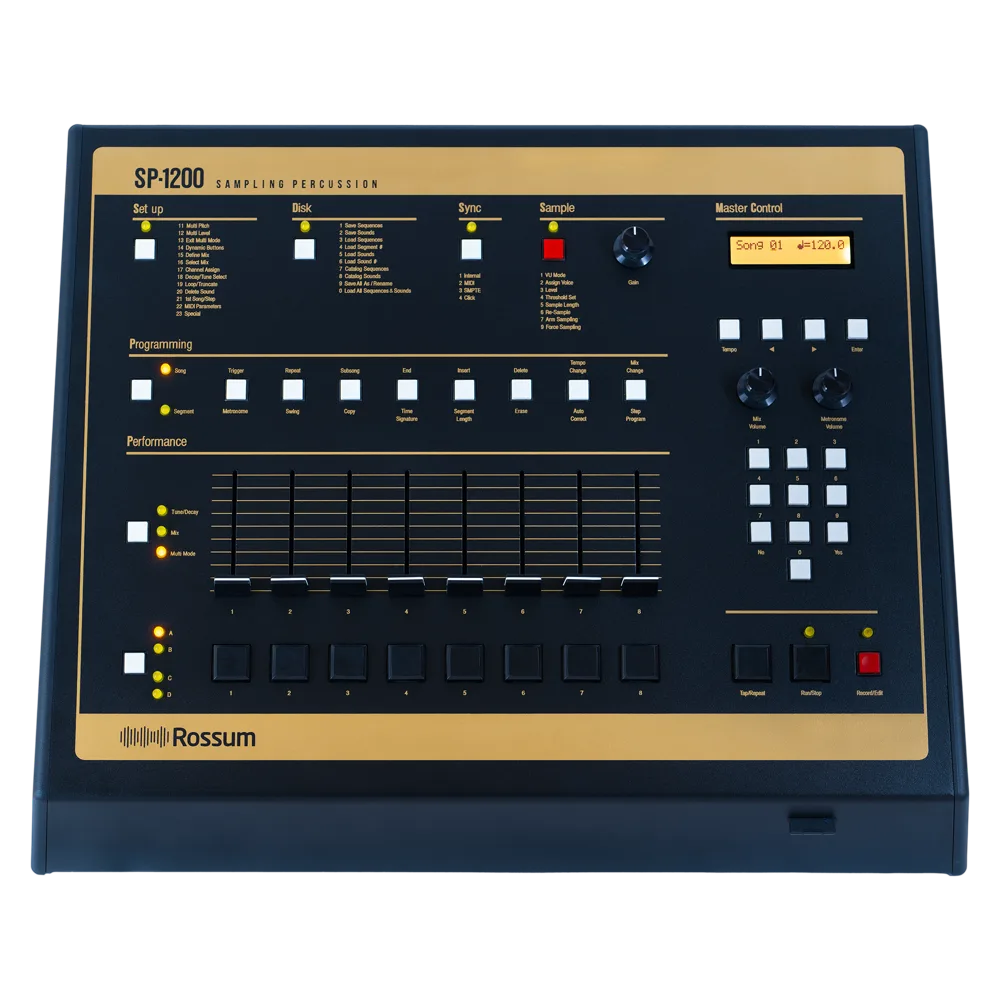
The latest in the SP-12 family, the Rossum SP-1200 is an authentic reissue of the iconic classic SP-1200 sampling percussion system, recreated by its original designer, E-mu Systems co-founder Dave Rossum, to preserve the coveted sound and character of the vintage instrument.
The final edition. Marking forty years of the SP sampling percussion system, the 40th Anniversary Edition is a numbered, limited run of just 100 units worldwide, and the last SP-1200 reissues that will ever be produced, as several of the original components are no longer obtainable. Each unit wears metallic-ink legends on its black powder-coated panels and ships with a numbered 40th Anniversary poster, printed in gold foil on acid-free paper.
Building on the engineering of 2020's 35th Anniversary SP-1200 Renovation, including study and analysis of many vintage units using modern technology not available during the original production run, the team determined that virtually all original components ought to be used to deliver the sound at the very highest standard of precision. Original SP-12 and SP-1200 designer Dave Rossum duplicated the original analog and digital electronics of the landmark 12-bit drum machine sampler as closely as is possible thirty-five years after its debut.
Changes and enhancements were made only where compatible with the original design, without compromising the classic vintage sound. Sampling memory has been expanded to the maximum capability of the original sound engine, and an all-new memory card storage solution is seamlessly integrated into the operating system, letting musicians save, rename, and delete files and folders, and import vintage SP-1200 disk images in the popular .HFE format. An included 3.5" disk with modified software lets users transfer all sounds and sequences from an original SP-1200 to the reissue over a standard MIDI cable.
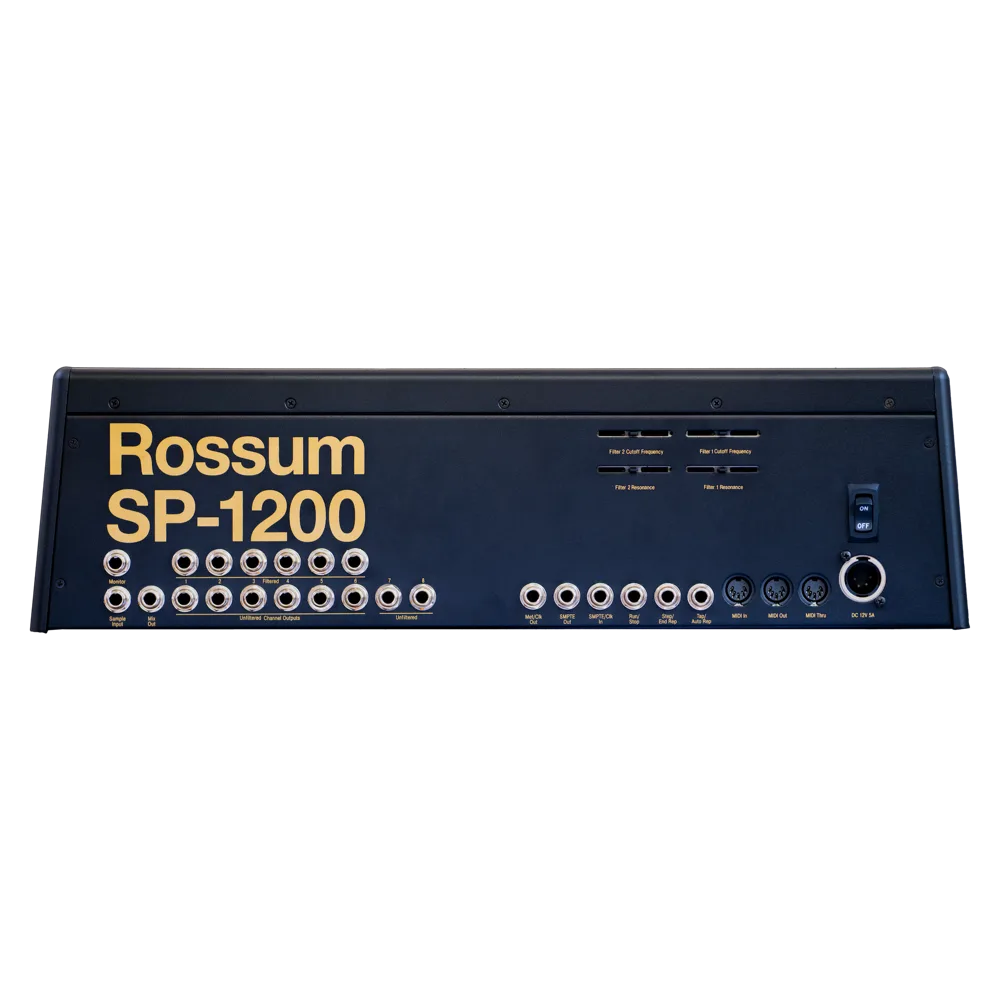
On the rear panel, users find new dedicated jacks for filtered and unfiltered channel outputs plus a new sample input monitor feature. Four sliders reaching just over the edge of the front panel tune the initial cutoff frequency and resonance of the SSI2144 analog dynamic filters on channels 1 and 2. The reissue ships with a new power supply featuring a locking, XLR-style connector, and a steel-and-aluminum case in the classic original shape.
A continuation of Dave's fifty-year tradition of instruments made to last, the SP-1200 reissue is expertly engineered for decades of reliability and built locally in the United States, close to Rossum's California headquarters so its sonic character is delivered to the most exacting quality standards.
Authentic to the Smallest Detail
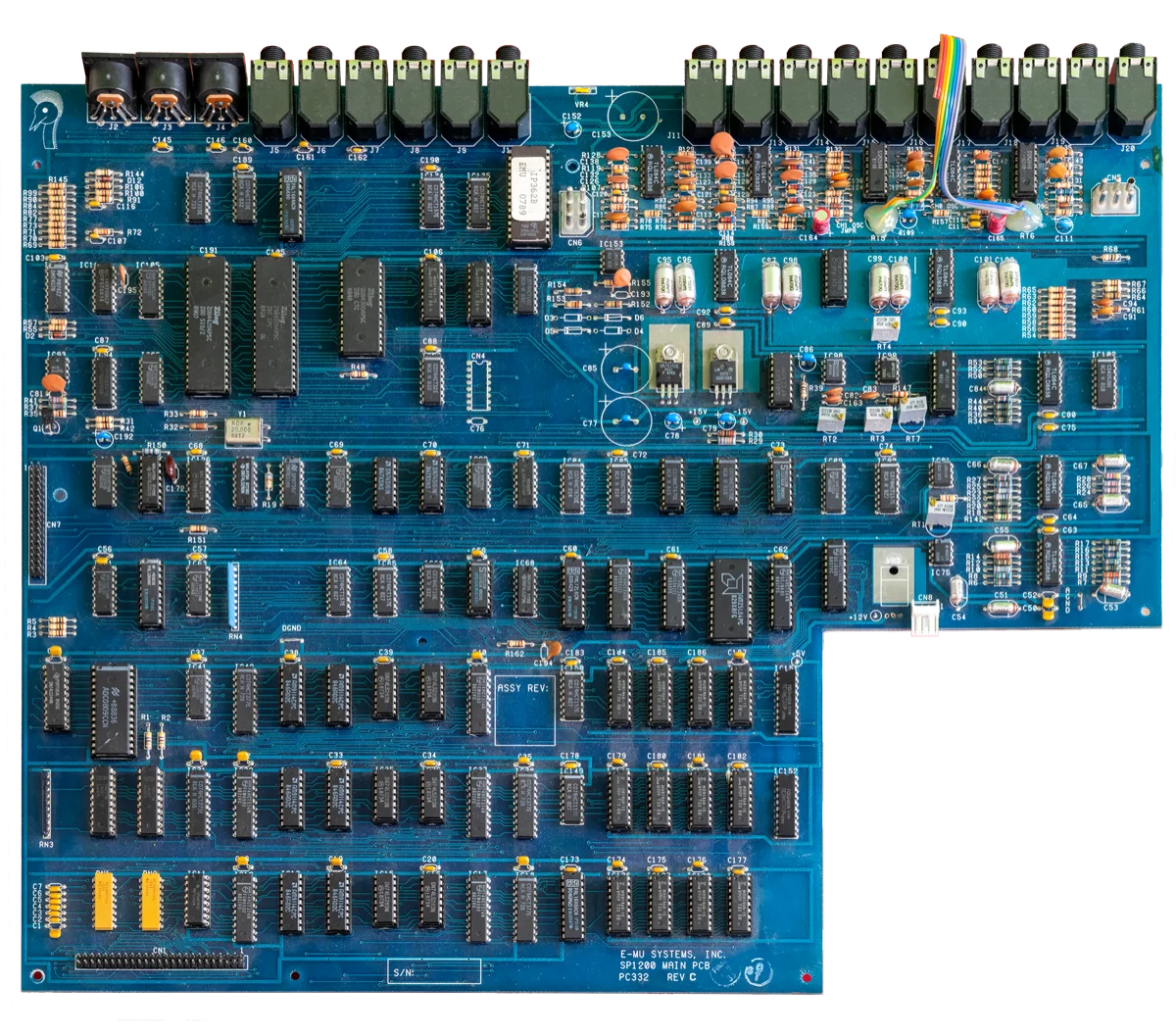
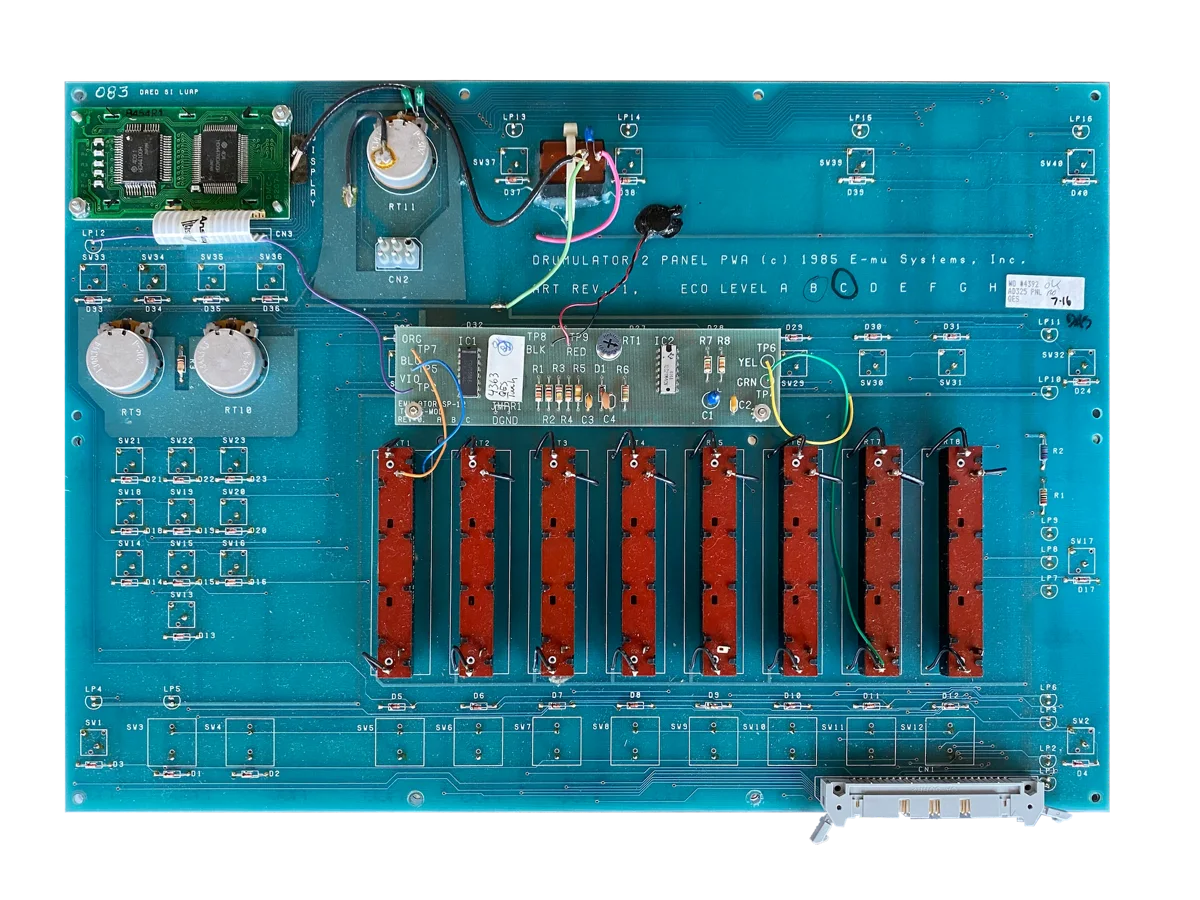
How faithful is the reissue? Point for point, the same. With very few exceptions, authentic components exactly the same as those in the vintage classic are used throughout, and great care was taken to preserve the original SP-12 and SP-1200 circuit-board layouts. Inside and out, the SP-1200 is faithful to the original operation and should sound exactly the same, even to the most discerning ears.
Drag the sliders to compare the reissue against the machines that started it all.
 Rossum · 2021
 Rossum · 2021
The sound. The unmistakable character of SP-1200's authentic, original pitch shifting and its audible aliasing and imaging artifacts are preserved identically. The reissue maintains exactly the same 12-bit linear data format and 26.04 kHz sampling rate found in every vintage SP-12 and SP-1200.
The filter. One of the unobtainable parts in the original SP-1200 is the SSM2044 analog filter, a classic integrated circuit designed by Dave Rossum in the early 80s based on classic improved ladder filter topology. In partnership with Sound Semiconductor, Inc., Dave designed the SSI2144 IC, which reprises the same analog circuit using contemporary IC processing and packaging, preserving its unique character. Four sliders tune the initial cutoff frequency and resonance on channels 1 and 2. Where the original required trim pots, the sliders let musicians set and leave their settings or move them in real time to add dimension to a performance.
Double the memory. For the first time, all reissue units feature 20 seconds of sampling time. The original sound engine designed by Dave Rossum in 1984 could accommodate up to 20 seconds, but 20th-century RAM prices proved cost-prohibitive during the original production run. Even compositions that used the full 10 seconds available from a vintage unit can be revised and remixed with an additional 10 seconds.
Lower noise, same artifacts. The reissue's redesigned power supply and newly-constructed four-layer circuit boards lower the noise floor and avoid undesirable hums without compromising the unique artifacts and dynamics characteristic of the SP-12 series. The rear panel runs cool to the touch, requiring no vents.
Specifications
12-Bit Bliss
SP-1200 maintains exactly the same 12-bit linear data format and 26.04 kHz sampling rate as all vintage SP-12 and SP-1200 units: the source of its unmistakable character.
The sound. The unmistakable character of SP-1200's authentic, original pitch shifting and its audible aliasing and imaging artifacts are preserved identically. The reissue maintains exactly the same 12-bit linear data format and 26.04 kHz sampling rate found in every vintage SP-12 and SP-1200.
The filter. One of the unobtainable parts in the original SP-1200 is the SSM2044 analog filter, a classic integrated circuit designed by Dave Rossum in the early 80s based on classic improved ladder filter topology. In partnership with Sound Semiconductor, Inc., Dave designed the SSI2144 IC, which reprises the same analog circuit using contemporary IC processing and packaging, preserving its unique character. Four sliders tune the initial cutoff frequency and resonance on channels 1 and 2. Where the original required trim pots, the sliders let musicians set and leave their settings or move them in real time to add dimension to a performance.
Double the memory. For the first time, all reissue units feature 20 seconds of sampling time. The original sound engine designed by Dave Rossum in 1984 could accommodate up to 20 seconds, but 20th-century RAM prices proved cost-prohibitive during the original production run. Even compositions that used the full 10 seconds available from a vintage unit can be revised and remixed with an additional 10 seconds.
Lower noise, same artifacts. The reissue's redesigned power supply and newly-constructed four-layer circuit boards lower the noise floor and avoid undesirable hums without compromising the unique artifacts and dynamics characteristic of the SP-12 series. The rear panel runs cool to the touch, requiring no vents.
"Over 35 years in the making, the team at Rossum cannot wait to hear what musicians create on new SP-1200 instruments."
Manuals & Guides
Firmware & Software
Firmware
FAQ
Overview
What is the Rossum SP-1200?
The Rossum SP-1200 is an authentic reissue of the E-mu SP-1200, the 12-bit sampling drum machine that defined golden-age hip-hop. It was designed by Dave Rossum, the E-mu Systems co-founder who created the original SP-12 and SP-1200. The reissue reproduces the original analog and digital electronics using virtually all original-spec components. It builds on the 2020 35th Anniversary Renovation, for which the team studied vintage units with modern analysis tools to maximize authenticity. Standard production ran from 2021 to 2025.
What's different or improved versus the original E-mu SP-1200?
The Rossum SP-1200 duplicates the original's analog and digital electronics and adds a set of modern conveniences. It keeps the same 12-bit / 26.04 kHz sound character while updating storage, memory and I/O. The main additions over the original are:
- 20 seconds of sampling time, double the original 10
- SD card storage in place of 3.5″ floppy disks
- dedicated filtered and unfiltered channel outputs
- a sample input monitor output
- an RGB-backlit display
What is the SP-1200 40th Anniversary Edition?
The SP-1200 40th Anniversary Edition is the final SP-1200 reissue production run, limited to 100 units worldwide. It commemorates the 40th anniversary of the SP-12 (1985), the first instrument in the SP family. The core electronics, sound engine and features match the standard SP-1200.
What is the difference between the various SP-1200 editions?
Rossum has released four SP-1200 versions that share the same core sound engine and functionality:
- 35th Anniversary SP-1200 Renovation (2020), a very limited run of of original rebuilt SP-1200 units priced at $7,500
- SP-1200 Reissue (2021-2025), the faithful main-production recreation at $3,999
- E-A-SKI Special Edition (2023), a 50-unit red collaboration edition
- 40th Anniversary Edition, the final run of 100 units in a gold on black finish priced at $4,999
40th Anniversary Edition: Rossum has released four SP-1200 versions that share the same sound engine and features. The 35th Anniversary Renovation (2020) was a first very limited run of rebuilt original units. The standard SP-1200 (2021-2025) was the main Reissue production. The 40th Anniversary Edition is the final run of 100 units with a black and gold finish. The E-A-SKI Special Edition (2023) is a 50-unit red edition.
E-A-SKI Special Edition: Rossum has released four SP-1200 versions that share the same sound engine and features. The 35th Anniversary Renovation (2020) was the first, a very limited run. The standard SP-1200 (2021-2025) is the main-production recreation. The 40th Anniversary Edition is the final run of 100 units with black and gold cosmetics. The E-A-SKI Special Edition (2023) is a 50-unit red edition.
35th Anniversary Renovation: Rossum has released four SP-1200 versions that share the same sound engine and features. The 35th Anniversary Renovation (2020) was the first, a very limited run. The standard SP-1200 (2021-2025) is the main-production recreation. The 40th Anniversary Edition is the final run of 100 units with black and gold cosmetics. The E-A-SKI Special Edition (2023) is a 50-unit red edition.
Is the 40th Anniversary Edition really the last production of the SP-1200 reissue?
Yes. The 40th Anniversary Edition is the final SP-1200 run, due to the unavailability of required parts, especially the discontinued Z80 CPU. Dave Rossum has expressed interest in future drum machine designs.
What is the SP-1200 E-A-SKI Special Edition?
The SP-1200 E-A-SKI Special Edition is a limited SP-1200 reissue created with multi-platinum producer E-A-SKI. It was limited to 50 units worldwide. It has a red and black colorway, exclusive sound content and a signed certificate of authenticity. The instrument itself is the standard SP-1200.
What is the SP-1200 35th Anniversary Renovation?
The SP-1200 35th Anniversary Renovation (2020) was the first Rossum SP-1200 reissue, a very limited initial run. It marked the 35th anniversary of the SP-12 (1985), the first instrument in the SP family. The engineering effort behind it, studying and analyzing vintage units with modern tools, became the basis for all later SP-1200 production.
Editions & Pricing
Will Rossum ever make any more SP-1200 Reissue units?
No. The SP-1200 reissue cannot be produced any longer because key parts are no longer available, in particular the discontinued Zilog Z80 CPU. The 40th Anniversary Edition was the final production run. Dave Rossum has expressed interest in future drum machine designs as new instruments rather than more reissue units.
How much does (or did) the SP-1200 cost?
The standard SP-1200 was $3,999. The 40th Anniversary Edition is $4,999. The 35th Anniversary Renovation from 2020 was priced $7,500.
Sound & Authenticity
Does the Rossum SP-1200 Reissue sound exactly like an original E-mu SP-1200?
Yes. The Rossum SP-1200 uses the same 12-bit linear data format and 26.04 kHz sampling rate as every vintage SP-12 and SP-1200. It runs the same Z-80 processor and memory map. It uses authentic components wherever available. The discontinued SSM2044 is replaced by the SSI2144, both designed by Dave Rossum on the same improved ladder topology.
Was the original pitch-shifting algorithm faithfully replicated?
Yes. The Rossum SP-1200 reproduces the complete original SP-1200 sound engine. It uses the same 12-bit linear data format and 26.04 kHz sampling rate as every vintage SP-12 and SP-1200, running on original-spec components in the classic board layout. Its pitch-shifting behaves like a vintage unit, artifacts and all.
What analog filters does the SP-1200 use, and why the SSI2144 chip?
The SP-1200 uses SSI2144 analog filter chips to recreate the original's filter sound. The original SP-1200 used SSM2044 filter ICs designed by Dave Rossum in the early 1980s, which are no longer manufactured. Sound Semiconductor released the SSI2144 in collaboration with Dave Rossum to faithfully recreate the original analog circuit. Four sliders on the rear panel tune the initial cutoff frequency and resonance of the filters on channels 1 and 2.
Does the SSI2144 sound the same as the SSM2044?
Yes. The SSI2144 is an authentic successor to the discontinued SSM2044. Sound Semiconductor developed it with Dave Rossum, who designed the original SSM2044, to reproduce the same filter character on the same improved ladder topology.
Sampling & Memory
How much sampling time does the SP-1200 have?
The SP-1200 has 20 seconds of total sampling time, double the original's 10 seconds. The original sound engine always supported 20 seconds. In 1987 the cost of RAM held production models to 10. Rossum expanded the memory to the maximum the original engine can handle and it cannot be expanded beyond that.
How is the sampling time distributed across channels?
The 20 seconds is split into eight blocks of 2.5 seconds each. You allocate the blocks across the eight channels to fit your samples. A single sound can therefore be up to 2.5 seconds long.
Filters & Outputs
Which channels have analog filters, and why do the outputs sound different?
The eight channels carry different fixed filtering, which is why their outputs sound different:
- Channels 1-2: dynamic analog filters, adjustable via the four rear-panel sliders (cutoff and resonance per channel)
- Channels 3-4: filters at a lower fixed cutoff
- Channels 5-6: filters at a higher fixed cutoff
- Channels 7-8: no filters, raw DAC output
The rear-panel filtered and unfiltered output jacks correspond to these configurations. You can pick the exact character you want per channel. The mix output sums all eight channels and applies no filtering of its own. Channels 1-2 still arrive there with their filtered character, which is why they sound darker in the mix.
How do I adjust the rear-panel filter sliders?
The four rear-panel sliders set cutoff frequency and resonance for channels 1 and 2. As the sliders are varied toward the center of the SP-1200 unit, the cutoff frequency and resonance levels are increased.
Can I disable the channel 1-2 filter envelopes?
Yes. Pn firmware v1.02 and newer, hold the TUNE/MIX/MULTI button during power-on. The SP-1200 will boot with the channel 1-2 filter envelopes disabled. The display shows "Filter Envs Off" to confirm.
What audio outputs does the SP-1200 have?
The SP-1200 has dedicated rear-panel jacks for filtered and unfiltered channel outputs plus the standard mix output, and a dedicated sample input monitor output.
Storage & SD Card
How does storage work on the SP-1200?
The SP-1200 stores samples and sequences on an SD memory card, in place of the original SP-1200's 3.5″ floppy drive. A built-in file manager lets you save, rename and delete files and folders on the card directly from the front panel. The system also imports vintage SP-1200 disk images in the common .HFE format.
How do I create folders on the SD card?
Use Set-up Special Function 27 to create folders directly on the SP-1200. This organizes sounds and sequences on the card without a computer.
Can the SP-1200 read original floppy disks?
No. The reissue has no floppy drive. The SP-1200 reads .HFE-format disk images from the SD card instead.
You can connect an original SP-1200 with a MIDI cable and use the new Special Function (26) of the included Transfer OS Disk to transfer the contents of a floppy from an original SP-1200 to a reissue.
My SD card isn't recognized or shows "no card." What do I do?
Work through these steps in order before assuming a fault:
- Toggle the SD card's lock switch and reinsert the card.
- Format the card as FAT32.
- Insert the card with the unit powered off, then power on.
- Avoid hot-swapping cards while the unit is running.
If the card still isn't recognized after this, contact support.
MIDI & Integration
Can I use the SP-1200 with an external MIDI keyboard, sequencer, DAW?
Yes. The SP-1200 has standard 5-pin MIDI In, MIDI Out, and MIDI Thru ports that can be used to connect it with other instruments. You can trigger samples from an external keyboard, use the SP-1200 as a sound module, or sequence it from a DAW or hardware sequencer. Pease see the original SP-1200 owner's manual for the note map.
Can I transfer sounds and sequences from an original SP-1200?
Yes. Every Rossum SP-1200 ships with a 3.5″ floppy disk of modified software for original vintage units. That floppy adds a new Set-up Special Function (26) to the original vintage unit, which transfers all its sounds and sequences to the reissue over a standard MIDI cable. It works with both original floppy drives and floppy-emulator modifications. You can also import .HFE images directly on the SD card.
Can I transfer samples into the SP-1200 via MIDI SDS?
Yes, you can send sounds via MIDI Sample Dump Standard (SDS). Create a blank sample first, then send the audio to it as 12-bit.
How does MIDI velocity work with the SP-1200?
The SP-1200 responds to MIDI velocity on incoming note messages.
When Dynamic Buttons is disabled (Set-up 14), the buttons always trigger at maximum velocity.
Connectivity
How do I connect turntables or stereo sources to the SP-1200's mono input?
Sum a stereo source to mono, or choose one side of the recording to sample into the SP-1200's sample input. A turntable also needs a phono preamp first to amplify and equalize the music for playback.
Operation
How do I stop a sound from playing during a performance, like a choke group?
To stop a sound that's still ringing out, trigger another sound assigned to the same channel. Multiple sounds may be assigned to one channel, and only one of them may play at a time. Triggering one will cut off any others playing. As a workaround, some users incorporate a blank or silent sound assigned to the same channel and trigger it to cut off the sound.
What gain setting should I use for the sample input?
Use the lowest gain that still gives a healthy level on the VU meter. The sample input offers up to +40 dB of gain. Start low and raise the gain control and until the level reads well without clipping.
Hardware & Display
Can the display backlight color be changed on the SP-1200 Reissue?
The SP-1200 uses a 2-line, 16-character display like the original, now backlit with RGB LEDs.
Use Set-up Special Function 26 to adjust the brightness and color to suit your studio or performance environment.
Genres
Is the SP-1200 good for genres beyond hip hop?
The SP-1200 works for any genre. The 12-bit / 26.04 kHz sound, the 2.5-second maximum per sample and the 240 BPM tempo ceiling all shape it toward that workflow. Beyond hip-hop, house, techno, and electronic producers have long used the SP-1200 for its punchy 12-bit sound and fast hands-on workflow.
Firmware & Updates
How do I update the SP-1200's firmware?
Update Main firmware from an SD card. Insert the card with the firmware file and follow the on-screen prompts. Get the current file from Rossum (download: v1.04). The separate EEPROM update, for the filter-envelope-disable feature, follows its own procedure on the Rossum documentation page.
Troubleshooting
What does the error message "Read Error 43" mean?
Main firmware v1.01 addressed the issue causing Read Error 43 messages. Update to the current v1.04 (download: v1.04) to resolve it.
Hardware & Repairs
What should I do if my SP-1200 will not power back on?
Please contact support for troubleshooting or to arrange repair. Please include your serial number, shipping information, and a description or video of the problem.
The 40th Anniversary Edition
What makes it different from the standard SP-1200 (2021-2025)?
40th Anniversary Edition: The core electronics, sound engine and features are identical to the standard SP-1200. The differences are cosmetic and collectible. It has black powder-coated steel panels with machined aluminum side and end caps in a black and gold colorway. It also includes a numbered limited-edition 40th Anniversary poster, printed in gold foil on acid-free paper.
E-A-SKI Special Edition: The E-A-SKI Special Edition differs from the standard SP-1200 in cosmetics and content. It has a red top and rear-panel silkscreen with the E-A-SKI logo, and side caps silkscreened with E-A-SKI's and Dave Rossum's signatures. It preloads four exclusive drum kits curated by E-A-SKI, 16 sounds each for 64 sounds total. These E-A-SKI Drums are exclusive to this edition and are not sold separately. Each unit includes a numbered certificate of authenticity signed by both E-A-SKI and Dave Rossum.
How much does the SP-1200 40th Anniversary Edition cost?
The SP-1200 40th Anniversary Edition is $4,999. That is $1,000 more than the standard SP-1200 ($3,999).
The E-A-SKI Special Edition
Are the electronics or sound engine different?
No. The core instrument is identical to the standard SP-1200 in every technical respect. Only the cosmetics and the preloaded content differ.
How much did the SP-1200 E-A-SKI Special Edition cost?
The SP-1200 E-A-SKI Special Edition was $3,999, the same price as the standard SP-1200.
The 35th Anniversary Renovation
How does it differ from the standard SP-1200 (2021-2025)?
The core electronics and sound are identical to the standard SP-1200. The 35th Anniversary Renovation was the initial run, with slightly different cosmetic details and a higher price that reflected the engineering investment. The standard 2021-2025 reissue added cost-optimized solutions, particularly the enclosure, while keeping identical audio fidelity. Both share the same 12-bit / 26.04 kHz sampling, 20-second memory, SD card storage, SSI2144 filters and RGB-backlit display.
How much did the SP-1200 35th Anniversary Renovation cost?
The SP-1200 35th Anniversary Renovation was $7,500. That is more than the standard SP-1200 ($3,999) because the research and tooling costs were spread across a very small run.