Modulate the Resonant Frequency Through Zero
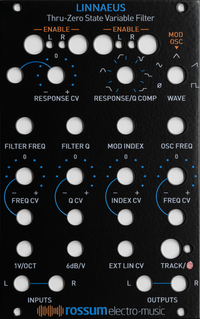
Linnaeus invites and rewards real-time interaction, manipulating the filter's natural response curve in entirely new ways to create subtle and dramatic timbral effects. At the same time, its "Ping Mode" makes it a powerful no-input, self-contained stereo oscillator and FM percussion voice.
This compact 16 HP module gives you the unique ability to maintain stability, even as you linearly modulate its resonant frequency through zero into negative ranges. Extensive voltage control of nearly every parameter and an intuitive one-knob-per-parameter interface let you manipulate the filter in entirely new ways.
To fulfill all of your audio or CV filtering needs, Linnaeus features an ultra-wide frequency range. Precise 1V/OCT and attenuverted CV inputs make Linnaeus exponentially voltage-controllable from sub-audio to ultrasonic.
Most state-variable filters provide fixed response outputs. Linnaeus channel output response characteristics are independently and continuously variable from Lowpass, through Bandpass, Highpass and Notch, to Low and High Shelving characteristics. Voltage control of the response characteristics is independently selectable for each of the two channels.
Linnaeus lets you program linear thru-zero modulation without needing an external modulation source. Just use its integrated modulation oscillator. You can always use any external source, via its External Linear FM modulation input. Process stereo signals or 2 independent mono signals through Linnaeus's true stereo ins and outs.
Specifications
| Topology | State-variable |
| Response characteristics | Lowpass · Bandpass · Highpass · Notch · Low/High Shelving |
| Response control | continuously variable, voltage-controllable per channel |
| Frequency range | sub-audio to ultrasonic, ultra-wide |
| Thru-zero FM | linear, through zero into negative ranges |
| Modulation oscillator | integrated |
| External FM | Linear FM input |
| Channels | true stereo, or 2 independent mono |
| Pitch CV | 1V/OCT |
| CV inputs | attenuverted |
| Ping Mode | self-contained stereo oscillator & FM percussion voice |
| Width | 16 HP |
What a Thru-Zero State-Variable Filter Does
A state-variable filter exposes multiple response shapes from one resonant core; making it thru-zero lets you drive that resonant frequency past zero into negative territory while staying stable.
State-variable response. Most state-variable filters give you fixed Lowpass, Bandpass and Highpass outputs. Linnaeus instead makes each channel's response continuously variable (sweeping from Lowpass, through Bandpass, Highpass and Notch, to Low and High Shelving), with that response characteristic independently voltage-controllable for each of the two channels.
Thru-zero modulation. Linear frequency modulation normally becomes unstable as the resonant frequency approaches zero. Linnaeus is engineered to stay stable as you modulate linearly through zero into negative ranges, using either its integrated modulation oscillator or an external source via the Linear FM input.
Stereo and Ping Mode. Because Linnaeus is true stereo, you can process a stereo signal or two independent mono signals. Engaging Ping Mode turns the module into a no-input, self-contained stereo oscillator and FM percussion voice with its own sonic flavor.
"Linnaeus invites and rewards real-time interaction, manipulating the filter's natural response curve in entirely new ways."
Manuals & Guides
Firmware & Software
Firmware
FAQ
Overview
What is Linnaeus?
Linnaeus is a stereo analog state-variable filter for Eurorack. It can modulate its resonant frequency through zero into negative frequency while staying stable, which is its defining feature. Nearly every parameter is voltage-controllable, through a one-knob-per-parameter layout. An alternate Ping Mode turns Linnaeus into a self-contained stereo oscillator and FM percussion voice.
Sound & Function
What filter types does Linnaeus offer?
Linnaeus's response is continuously variable across lowpass (12 dB/oct and 6 dB/oct), bandpass, highpass (12 dB/oct and 6 dB/oct), notch, low shelving and high shelving. You sweep between them smoothly. There are no discrete mode switches.
How do I select and sweep between Linnaeus's filter responses?
Each of Linnaeus's two channels has a Response Enable control that continuously sweeps its output from Lowpass, through Bandpass, Highpass and Notch, to Low and High Shelving. Lowpass and highpass are available at both 12 dB/oct and 6 dB/oct slopes. Because the control is continuous, you morph smoothly between response types rather than switching in steps. Response is also voltage-controllable. An attenuverted response CV input can move the characteristic under modulation. Individual Response CV Enable controls turn that CV control on or off per channel. The two channels share the filter's cutoff and Q. They set their response separately. You can run a lowpass on one channel and a highpass on the other while both track the same frequency.
What is thru-zero frequency modulation on a filter?
Standard FM modulates the cutoff frequency but cannot go below zero. It "bounces" off the bottom and creates asymmetric artifacts. Linnaeus can modulate smoothly through zero Hz into negative frequency while staying mathematically stable. This produces distinctive timbral textures, especially at high modulation depths.
How deep can Linnaeus's thru-zero FM go (the modulation index)?
Linnaeus's thru-zero FM depth is set by the modulation index. The internal modulation oscillator's output is summed with the External Linear FM input and fed to a modulation-index VCA, which scales the linear thru-zero index from zero up to 8X. The index is itself voltage-controllable through an attenuverted CV input. At a low index you get gentle vibrato or subtle timbral movement. At a high index you reach deep, clangorous FM and percussive metallic tones. Because both the modulation-source level and the index are voltage-controllable, you can play FM depth dynamically from envelopes or other CV.
Does Linnaeus have a built-in modulation oscillator?
Yes. An integrated modulation oscillator gives continuously variable waveforms from off through sine, triangle, sawtooth and square. Its frequency is exponentially voltage-controllable and can optionally lock to track the filter's cutoff. You can get dramatic FM filter effects without any external modulation source.
Is Linnaeus truly stereo?
Yes, with one distinction. Linnaeus has stereo inputs and outputs and can process a stereo signal or two independent mono signals. The two channels share the filter's cutoff and resonant frequency. Their response characteristics (LP/BP/HP/notch/shelving) can be set independently per channel through dedicated enable switches. This allows creative stereo effects, for example lowpass on the left channel and highpass on the right.
What is Ping Mode?
Press and hold the Egg button and Linnaeus enters an alternate firmware mode. It becomes a self-contained stereo oscillator and FM percussion voice with no audio input required. Trigger the filter with gate signals to create pitched percussion, metallic tones and FM textures. Some users have built entire sample libraries from Ping Mode alone.
Can Linnaeus track 1V/Oct for melodic use?
Yes. Linnaeus has a precise 1V/Oct input and tracks accurately from sub-audio to ultrasonic frequencies, across a range well beyond 10 octaves.
What frequency and resonance range does Linnaeus cover?
Linnaeus's cutoff and resonant frequency is exponentially voltage-controllable from sub-audio to ultrasonic, driven by a precise 1V/oct input and an attenuverted CV input. Its resonant gain (Q) is exponentially voltage-controllable from 0 dB to more than 60 dB, through a 6 dB/V input and an attenuverted CV input. That range lets Linnaeus work as a slow, sweepable tone-shaping filter and as a sharp, high-Q resonator that can ring or self-oscillate for tuned tones. Because both frequency and Q respond to exponential control, you can play the resonant peak as a pitched voice across a very wide span. The exponential Q gives fine command over resonance, from gentle emphasis up through extreme resonance.
Comparisons
How does Linnaeus compare to Evolution?
Evolution is a lowpass-only analog ladder filter with variable slope and drive. Linnaeus is a multimode state-variable filter with thru-zero FM and stereo I/O. Evolution is strong on thick, warm analog lowpass character. Linnaeus is more versatile for general filtering and stereo processing. In a single-filter system Linnaeus covers more ground. In a dedicated lowpass role Evolution has deeper character.
How does Linnaeus compare to Morpheus?
Morpheus is digital and Linnaeus is analog. Morpheus offers 289 filter configurations and 3D morphing, which makes it a sound-design tool. Linnaeus is a more immediate, hands-on filter with thru-zero FM and stereo operation. Morpheus reaches sounds that traditional filters cannot. Linnaeus does traditional filtering well and adds thru-zero FM on top.
Specifications & Power
How wide is Linnaeus and will it fit in my case?
Linnaeus is 16 HP wide and 25 mm deep. It fits any standard Eurorack case, including shallow skiffs.
What are Linnaeus's power requirements?
Linnaeus draws 155 mA on +12V and 36 mA on -12V. It uses a standard 16-pin Doepfer-style connector, needs no +5V rail and is reverse-polarity protected.
What CV inputs does Linnaeus have?
Linnaeus puts nearly every parameter under voltage control. Frequency has a precise 1V/oct input plus an attenuverted CV input. Resonance (Q) has a 6 dB/V input and an attenuverted CV input. An External Linear FM input handles thru-zero modulation, with an attenuverted CV input for the modulation index. Each channel's response can be swept by an attenuverted response CV input, enabled per channel by the Response CV Enable controls. The internal modulation oscillator's frequency also has an attenuverted CV input. Audio connections are stereo in and stereo out. The input labeled Ext Lin CV is also the port you play the firmware-update WAV into. Because most CV inputs are attenuverted, you set both the amount and the polarity of each modulation source.
Firmware & Updates
What firmware version is current for Linnaeus?
Linnaeus's current firmware is v1.03 (download: v1.03 WAV), released in May 2020. It corrected an issue with Manual and External Ping Mode.
How do I check which firmware version my Linnaeus has?
Press and hold the Right Response Enable button. After about 2 seconds, the top 4 LEDs show the version in binary. You do not need to read binary. Just compare the LED pattern to the latest version on the product page. The current version is 1.03_200529, whose LED pattern is Off, Off, On, On. If your module shows an earlier pattern and you use Ping Mode, updating is worthwhile. To update, play the firmware WAV into the Ext Lin CV input: power on while holding the Left Response CV Enable and Left Response Enable buttons, press Track, then play the file and follow the LED prompts.
How do I update Linnaeus firmware?
Play the firmware WAV file (download: v1.03 WAV) into the module's Ext Lin CV input from a computer, phone or audio interface. A few caveats matter:
- On Mac, Safari can corrupt the audio stream. Use QuickTime Player or another application instead.
- Quit all other apps that produce audio first.
- If you use an audio interface, make sure it outputs line level.
- If you use a phone, put it in Airplane Mode so notifications do not interrupt the stream.
Resources
Where can I find Linnaeus demos and videos?
Start with the Linnaeus product page, which has audio demos. The community ModWiggler thread also has many user examples and patches. Rossum continues to add demo content.
Replacement Parts
Genuine replacement panels and kits for your Linnaeus.